The Scorebook Before the Screen
Cricket scorekeeping turns scattered events into a readable record, from a pencil-marked book to a live display that shows how an innings is taking shape.
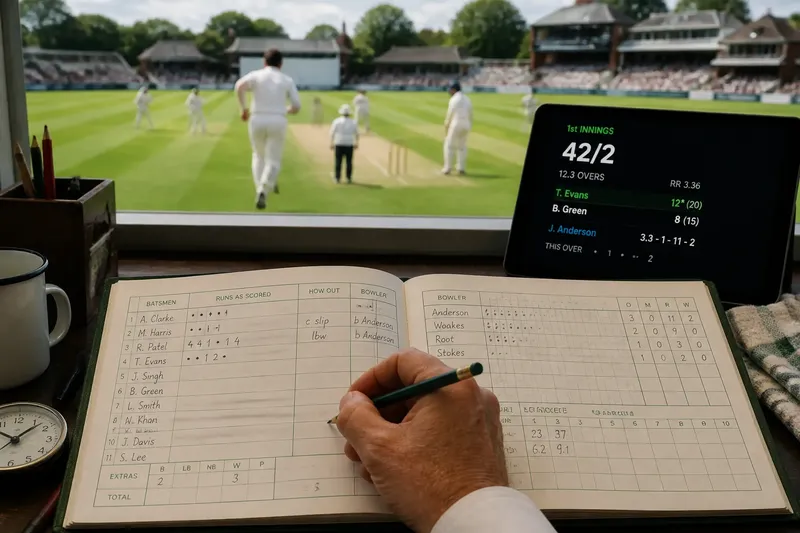
A scorer bends over a paper book as the bowler turns at the top of the run-up. A pencil moves: a dot, a run, perhaps a small mark beside the batter’s name. The crowd sees a ball disappear into the outfield; the scorebook makes that moment part of the innings. To understand cricket scorekeeping, follow the record as a scorer builds it, then notice what a modern screen preserves and what it can hide.
What does the scorebook record first?
A scorebook is not simply a tally of runs. It is a working account of how those runs, dismissals and deliveries came about. At its center are the batters, the bowler, the innings total, wickets lost and overs completed. Around those figures, a scorer keeps enough detail to connect each change to the ball that caused it.
Traditional books vary in layout, but many provide a grid for each batter’s progress and separate spaces for extras, dismissals and bowling figures. The scorer may use symbols, abbreviations and small marks to fit a complicated event into a compact space. Those marks are useful only if they can be read consistently later.
Before a match begins, the scorer identifies the teams, innings and players, and sets up the page or digital record. The batting order matters because each new batter must appear in the right place. The bowling record also needs the correct bowler attached to the correct passage of play. A mistaken name can make an otherwise accurate total hard to interpret.
How does a scorer turn one ball into a record?
After each delivery, the scorer works out what happened before entering it. Did the ball count as a legal delivery? Did a batter score from the bat, or did the batting side receive an extra? Was a wicket taken, and if so, which batter was dismissed and how? These are separate questions. The score is only clear when the entries preserve the distinctions.
A scoring grid often uses a box for each ball. A dot can indicate no run from the delivery; a run may be written as a number, with extra symbols or notes where needed. A boundary is recorded as the appropriate run value, while a dismissal needs its own mark and a description of the method. The exact notation depends on the book or system, so scorers should follow its legend rather than assume every mark is universal.
Extras deserve particular care. Byes and leg byes are not credited to the batter, while wides and no-balls are recorded as extras and affect the bowling figures differently. A no-ball or wide also changes how the delivery is treated in the over. The entry must capture both the runs and the status of the ball; writing only the new total loses useful information.
Imagine a batter taps the ball into the infield, and the pair complete one run. The scorer adds a run to the striker’s personal record and to the team total, then marks the delivery as a scoring ball. The strike changes, so the scorer must also keep track of which batter will face the next delivery. The written record is doing more than arithmetic: it is keeping the next moment intelligible.
Why did handwritten scoring matter?
Before electronic displays could show a live account, the scorebook was the durable record at the scorer’s table. A scoreboard could show the innings total, wickets and overs, but the book preserved the route to those figures. It could show who scored, which bowler conceded runs, when a wicket fell and how extras accumulated.
That record helped the match make sense beyond the boundary. Players and officials could consult it when checking figures; reporters could use it to describe an innings; spectators could follow a changing score from a board or a printed account. The book also let a scorer revisit an earlier entry when a later total seemed wrong. Its value was not that handwriting was inherently more reliable than a screen. It was that the entries, taken together, made a result traceable.
Scoring has long relied on local conventions and skill, not one universal visual language. A pencil mark might mean one thing in a particular book and another in a different scoring system. That is why a clear legend, tidy entries and regular checks matter. The scorer’s job is partly to record events and partly to make the record readable to another person.
What does a live display add?
A modern digital display can update the total quickly and present several layers of information at once: batter and bowler names, individual scores, overs, partnerships, fall of wickets and the latest delivery. A phone or stadium screen can put that account in front of people who are nowhere near the scorer’s table. In a broadcast, the score graphic can also sit beside the action, linking a new event to the innings already played.
But a display is an interface, not the match itself. It chooses which details to make prominent and which to tuck away. A large total may be easy to see while the distinction between a batter’s runs and extras takes another tap or another screen. A simple over summary can help a new viewer orient themselves, yet it may not explain why the bowler’s figures changed in a particular way.
Digital scoring can also make corrections easier to distribute. If an entry is corrected in the underlying record, the connected display may update without rewriting a board by hand. That convenience depends on accurate input and a system that is being maintained properly. A screen can repeat an error just as neatly as it can show a correct figure.
How can you read the record while watching?
Start with the team total and wickets lost, then check the overs completed. Those figures set the basic scene: how much of the innings has been played and how many batters have been dismissed. Next, look at the two current batters and the bowler. Their individual figures help explain whether the innings is being carried by one batter, shared across a partnership or shaped by a quiet spell.
When the score changes, ask what kind of event caused it. A run credited to a batter, an extra, a boundary and a wicket do not all tell the same story. If the total rises without the batter’s personal score changing, look for an extra. If a wicket falls, check who is out and which batter is entering; the innings has changed in a way the total alone cannot express.
Then use the ball-by-ball line, if the display provides one, to read the immediate sequence. Repeated dots can indicate pressure or careful bowling, but context matters: a batter may be content to wait, or may be struggling to score. A boundary changes the total sharply, though it does not by itself explain whether the batting side has control. Treat the display as a prompt to observe, not a substitute for watching the field and the players.
Say you glance up to see a team total rise by one while the striker’s score stays the same. You check the extras and see a bye recorded. That tells you the run came without being credited to the batter, and the delivery’s status may also affect how the over is counted. The score becomes a small explanation of what you missed, not just a new number.
What should a scorer check before moving on?
For someone keeping a practice scorebook, a brief check after each over can catch small slips before they spread. Compare the individual batter entries with the innings total, confirm the bowler’s figures, and make sure the over’s legal deliveries have been counted correctly. Check that each dismissal is assigned to the right batter and that extras are not accidentally added to a batter’s personal score.
- Names: Confirm the batter and bowler attached to the entry.
- Total: Reconcile batter runs, extras and the innings score.
- Dismissals: Record the player out and the method clearly.
- Bowling: Check runs conceded, wickets and completed overs.
- Delivery status: Mark whether the ball counts in the over, especially for wides and no-balls.
- Strike: Track which batter will face the next delivery after the event.
If the book uses unfamiliar symbols, refer to its instructions before making an entry. In an organized match, the official scoring system and the scorer’s procedures take precedence over a casual shorthand.
Which scorekeeping questions come up most often?
Is the scoreboard the official record?
A visible scoreboard is a convenient summary, but the official record is maintained through the match’s designated scoring process. A display may lag, omit detail or need correction, so a single screen should not be treated as the full account.
Why can the team total differ from the batters’ combined runs?
Extras add runs to the innings without adding them to a batter’s score. Byes, leg byes, wides and no-balls have different scoring treatments, which is why the extras line helps explain the difference.
Why does the record show a delivery that does not count in the over?
A ball can produce a recorded event without counting as one of the over’s legal deliveries. The scorer records what happened and separately tracks whether the ball counts toward the over.
Can a paper scorebook and a digital scorecard disagree?
They can if one record contains a missed or mistaken entry, or if an update has not reached the display. Comparing the ball-by-ball record, totals and player figures can help locate the point where the accounts diverged.
What can a scorebook show that a big number cannot?
A total tells you where an innings stands; the record tells you how it arrived there. It preserves the difference between a batter’s contribution and an extra, between a wicket and a quiet delivery, between a single moment and the pattern around it. Screens make that information easier to share, but the scorebook’s deeper function remains the same: turning a stream of events into a match another person can follow.
Next time you see a score change, trace it back one layer. Find the batter, the bowler, the delivery and the entry that explains the new figure. Cricket scorekeeping becomes much easier to read when the display is treated as a map of recorded events, not as a verdict on the match.